
Description
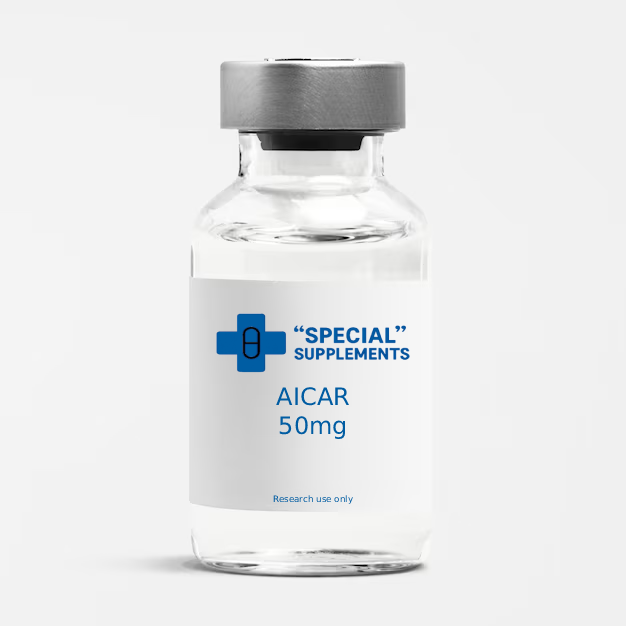
AICAR Peptide
AICAR (5-Aminoimidazole-4-carboxamide ribonucleotide) is a synthetic analog of adenosine monophosphate (AMP), a nucleotide involved in regulating cellular energy metabolism. It has been studied for its potential to activate AMP-activated protein kinase (AMPK), an enzyme that plays a central role in maintaining energy balance within cells. By activating AMPK, AICAR may influence metabolic processes that control glucose and lipid metabolism, autophagy, mitochondrial biogenesis, and inflammation.
AMPK activation is believed to shift cellular metabolism toward energy production by inhibiting anabolic (energy-consuming) pathways like protein and fatty acid synthesis, while stimulating catabolic (energy-generating) pathways such as glucose and fat breakdown. Through this mechanism, AICAR may potentially enhance glucose uptake in muscle tissue, improve insulin sensitivity, and support overall metabolic efficiency. Researchers have also suggested that AICAR might have anti-inflammatory and tissue-protective properties, as well as the potential to improve endurance in some experimental models.
—
**Chemical Makeup**
Molecular Formula: C9H15N4O8P
Molecular Weight: 338.21 g/mol
Other Known Titles: AICA Ribonucleotide, 5-Aminoimidazole-4-carboxamide Ribonucleotide
—
**Research and Clinical Studies**
**AICAR and Tissue Protection**
AICAR has been studied for its potential protective effects on tissues during ischemia and reperfusion injury. Research suggests it may reduce myocardial infarction size and improve cardiac function by activating AMPK, which helps cells adapt to low-oxygen conditions. Meta-analyses of multiple clinical trials indicate that AICAR may decrease cardiac tissue damage and cell death, improving experimental outcomes.
Mechanistically, AICAR may increase myocardial glucose availability by promoting glycogen breakdown (glycogenolysis) through AMPK activation. In animal models, AICAR was shown to raise levels of its active form, ZMP, which may allosterically activate glycogen phosphorylase, allowing heart tissue to produce energy even in oxygen-deprived states. This potential ability to preserve cellular energy balance under stress suggests a cardioprotective effect.
AICAR has also been studied for potential liver-protective actions. In murine models of ethanol-induced fatty liver, AICAR appeared to reduce fat accumulation and improve liver tissue structure. It was suggested to suppress the expression of SREBP-1c and fatty acid synthase (FAS), key regulators of lipid synthesis, indicating a possible role in reducing hepatic triglyceride production.
—
**AICAR and Insulin Sensitivity**
Research indicates that AICAR may enhance insulin sensitivity and glucose uptake in various tissues, largely through AMPK activation. In equine skeletal muscle studies, AICAR appeared to increase glucose transport and upregulate GLUT8 expression, a glucose transporter protein, without raising lactate levels. This response may support improved glucose metabolism and cellular energy balance.
Additional studies in muscle tissue show that both exercise and AICAR independently activate AMPK, increasing glucose uptake and improving metabolic function. AICAR may also influence key signaling pathways, such as the MAP kinase/ERK pathway, which helps regulate cell growth, metabolism, and stress response.
In liver tissue, AICAR has been observed to lower glucose output and plasma triglyceride levels while increasing fatty acid oxidation. These effects are thought to occur through phosphorylation of acetyl-CoA carboxylase, which inhibits fatty acid synthesis and promotes the use of stored fat for energy.
—
**AICAR and Endurance**
Experimental research suggests that AICAR may enhance endurance capacity by stimulating oxidative metabolism and mitochondrial biogenesis through AMPK activation. Studies in sedentary murine models reported up to a 44% increase in running endurance following AICAR administration, suggesting activation of the AMPK–PPARδ pathway, which regulates genes involved in energy metabolism and muscle adaptation.
Activation of this pathway is believed to increase mitochondrial density and promote a shift toward more oxidative muscle fibers, mimicking some effects of endurance training. Other studies noted that AICAR administration in animal models improved exercise performance and muscle function, potentially through enhanced autophagy and nitric oxide-mediated blood flow. These findings have led to growing interest in AICAR as a research compound for studying energy regulation and physical performance mechanisms.
—
**AICAR and Malignant Cell Lines**
AICAR has been investigated for its effects on cell apoptosis in certain cancer research models, particularly B-cell chronic lymphocytic leukemia (B-CLL). Studies suggest that AICAR may induce apoptosis through activation of caspase enzymes and the release of cytochrome C, independent of the p53 pathway. This process may involve AICAR’s conversion to its active intracellular form, ZMP, which activates AMPK and triggers apoptosis-related signaling.
Inhibitor studies indicated that blocking AICAR uptake or conversion reduced apoptosis and AMPK activation, underscoring ZMP’s importance in this process. Interestingly, normal B lymphocytes and B-CLL cells appeared similarly sensitive to AICAR-induced apoptosis, while T cells showed much lower sensitivity, suggesting cell-type-specific mechanisms of action.
—
**Summary**
AICAR is an AMP analog with wide-ranging research potential due to its ability to activate AMPK and influence metabolic pathways. Research findings suggest AICAR may:
* Support tissue protection during ischemia-reperfusion injury
* Enhance glucose uptake and insulin sensitivity
* Promote fatty acid oxidation and improve lipid metabolism
* Stimulate mitochondrial biogenesis and endurance adaptation
* Induce apoptosis in certain cell models through AMPK activation
Further research is needed to fully understand AICAR’s mechanisms, safety, and potential applications across different biological systems.
Reviews
There are no reviews yet.